Best practices for ads in AI assistants
Robin Lim8 min read
Best practices for ads in AI assistants
Short answer: Ads in AI assistants work best when they read like a useful answer to the question the user just asked. Name a specific product, price or offer, match the words the user is likely to use, and give one clear next step. To raise conversion rates, send people to a page that matches the ad, track conversions with a pixel or server-side API, and judge results on cost per sale rather than clicks.
Key takeaways
- Most AI assistant placements show one ad per answer, so relevance matters more than volume.
- Write ads as answers, not slogans. Graphite found 98% of ChatGPT ad copy was written new rather than reused from search.
- Target by context, such as the problem or product category in the conversation, rather than by keyword lists or personal data.
- Earlier turns perform better. The first four turns of a conversation drew 48% higher click rates in Similarweb and Graphite's data.
- Click rates are lower than search, so the landing page and conversion tracking decide whether a campaign pays.
- Label every placement as sponsored and never suggest the AI itself is recommending you.
Why do ads in AI assistants need different best practices?
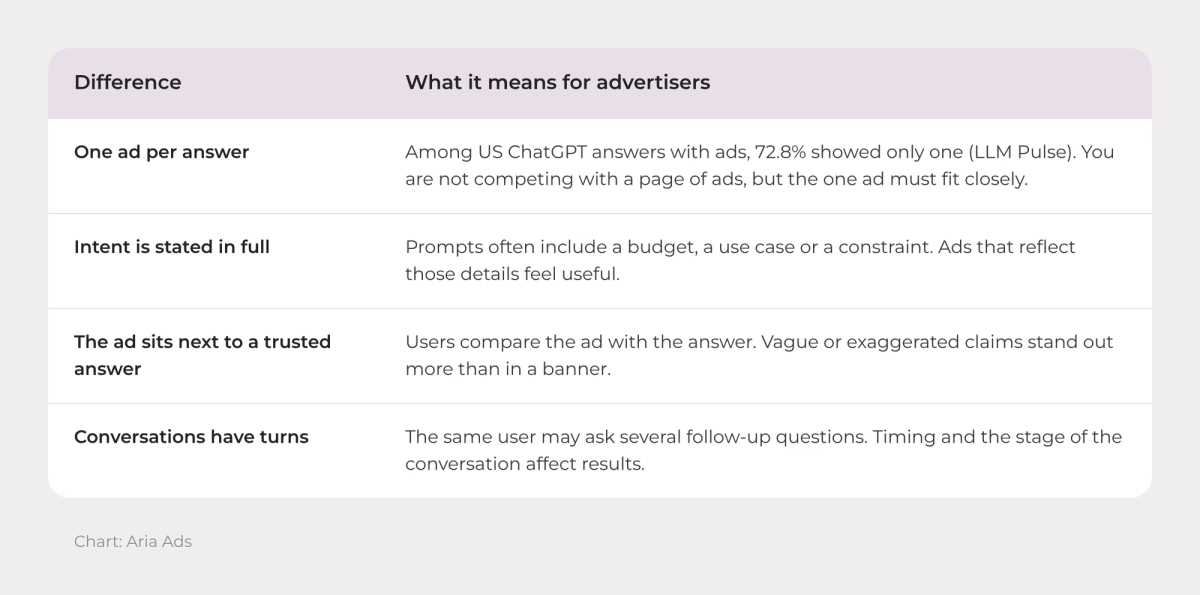
Conversational advertising differs from search and display in four ways that change how you write and measure ads.
Best practices for writing ad copy for AI assistant placements
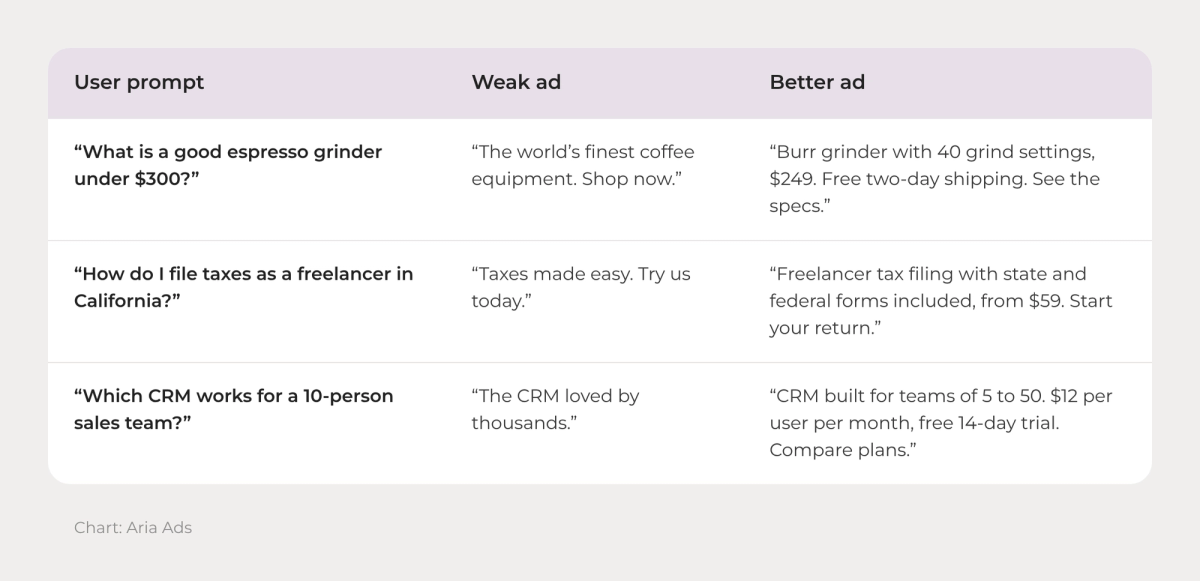
- Answer the question being asked. Write the ad as a direct, useful reply to a common prompt in your category. If the prompt is "best project management tool for a five-person team," the ad should say why your tool fits a five-person team.
- Lead with something specific. A product name, a price, a plan, a delivery time or an offer. Specific details give the user a reason to click.
- Use the user's words. Mirror the terms people use in prompts, such as "under $300," "for beginners" or "for flat feet," rather than internal product language.
- Give one clear action. "See plans," "Check availability" or "Get the guide." One action per ad performs better than several.
- Keep it short. The answer already gives context. The ad should add a concrete option, not repeat the explanation.
- Only make claims you can back. Avoid "best" or "number one" unless you can support them. Users can ask the assistant to check your claim in the next turn.
- Never imitate the assistant. Do not write "ChatGPT recommends" or copy the answer's voice. The ad should be helpful but clearly from the brand.
Write several versions by intent. Prepare one version for research questions, one for comparison questions and one for ready-to-buy questions.
Examples
How to use contextual targeting in AI ads
Contextual targeting matches an ad to the content of the conversation rather than to the user's identity or browsing history. It is the main targeting method in AI assistants. OpenAI's Ads Manager uses "context hints" that describe what your ad is about, plus location, platform and your own customer lists. It does not offer job title or company targeting. Ad networks for AI apps such as Aria Ads also match on context and never pass conversations to advertisers.
- Describe problems, not just products. Include the situations that lead to a purchase, such as "planning a ski trip" as well as "ski jackets."
- Cover the stages of a decision. Add contexts for research, comparison and purchase, and assign the right copy to each.
- Set exclusions. Exclude contexts where your ad would be unhelpful or unsafe, such as news about accidents for a car brand.
- Check category rules. Health, finance and other regulated categories have extra rules on most platforms. SE Ranking found ads on 28.69% of healthcare prompts in ChatGPT against 2.64% in Google AI Mode, so policies and delivery differ by platform.
- Review relevance. SE Ranking found 14.35% of ChatGPT ads were no more related to the question than a random ad. Review where your ads appear and tighten your context hints if matches are loose.
How do I improve conversion rates on AI chat ads?
Click rates in AI assistants are lower than in search. ChatGPT's average US click rate was 0.73% from March to September 2026, and one B2B test converted 0.8% of visitors against 6.64% on Google (StubGroup). That makes what happens after the click decisive.
- Match the landing page to the ad. If the ad names a product and price, link to that product page with that price, not the homepage.
- Design for mobile. Many people use AI assistants on their phones. Test the page and checkout on a phone before launch.
- Carry the context forward. Repeat the user's need on the landing page, for example "Grinders under $300," so the visitor knows they are in the right place.
- Track conversions properly. Install the platform's pixel, a server-side conversions API, or both. Confirm real events are arriving. Weak conversion data limits delivery on ChatGPT and on most networks.
- Choose the right pricing model. Use CPA when you only want to pay for sales or sign-ups. Use CPC for traffic and CPM for reach.
- Favor earlier turns. Similarweb found the first turn drew about 0.66% click rates against 0.36% to 0.48% for turns 5 to 21. If a platform lets you influence placement, prefer early-stage contexts.
- Make a clear offer. A trial, a discount for first orders or free shipping gives the user a reason to act now.
- Measure past the click. Compare cost per lead and cost per sale with search and social over the same weeks. One B2B advertiser paid $0.76 per click but had a lead cost of $92.21, which still beat Google's $157.57.
Which metrics should you track?
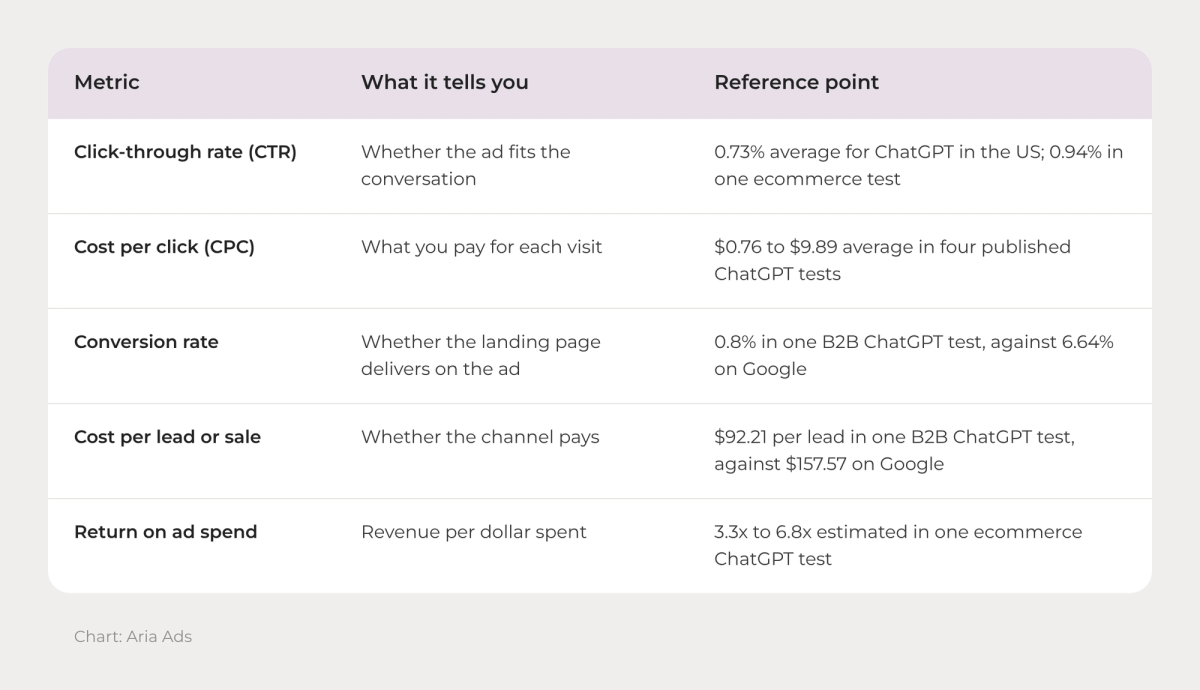
Each reference point comes from a single published account, so treat them as signals, not benchmarks.
How should AI ads be disclosed?
The US Federal Trade Commission's guidance on native advertising says ads must be clearly identifiable as advertising. In an AI assistant, that means three things: a visible "Sponsored" label, a clear visual separation from the answer, and no influence on what the assistant says. ChatGPT and Aria Ads both label each ad and show it in a separate card. Advertisers should keep their copy consistent with that label and avoid wording that suggests the AI chose them.
Checklist: launching an AI assistant ad campaign
- List the questions your buyers ask. Collect 20 to 30 real prompts from sales calls, support tickets and search data.
- Group them by stage. Sort prompts into research, comparison and purchase.
- Write one ad per group. Answer the question, add a specific detail and give one action.
- Set context and exclusions. Describe the problems and products you want to match, and the contexts you want to avoid.
- Build matching landing pages. One page per ad group, tested on mobile.
- Install conversion tracking. Pixel, conversions API or both, with a test event confirmed.
- Pick a pricing model and a target. Set a target cost per lead or sale before you spend.
- Run for at least two to four weeks. Allow time for the system to learn and for conversions to report.
- Review weekly. Cut weak ads, refine contexts and compare cost per sale with your other channels.
What mistakes should you avoid?
- Reusing search ads without rewriting them for conversation.
- Judging the campaign on clicks or click rate alone.
- Sending users to a homepage instead of a matching product page.
- Launching without working conversion tracking.
- Making claims the assistant could contradict in its next answer.
- Writing copy that blurs the line between the ad and the answer.
FAQ
How do I write ad copy for AI assistants?
Write the ad as a short, useful answer to a question your buyers ask. Name a specific product, price or offer, use the words people use in their prompts, and give one clear action. Avoid slogans and claims you cannot support.
How do I improve conversion rates on AI chat ads?
Link to a landing page that matches the ad, design it for mobile, repeat the user's need on the page, and track conversions with a pixel or server-side API. Use CPA pricing when you only want to pay for results, and compare cost per sale with your other channels.
What is a good click-through rate for AI chat ads?
There is no published benchmark across advertisers. ChatGPT's average US click rate was 0.73% from March to September 2026, and one ecommerce test reached 0.94%. Click rates were higher in Brazil, Mexico and Japan.
What is contextual targeting in AI ads?
Contextual targeting matches an ad to what the conversation is about, such as the product category or problem the user describes. It does not rely on the user's identity or browsing history. It is the main way ads are matched in AI assistants.
Should AI assistant ads be different from search ads?
Yes. Search ads compete with several other ads for a short keyword. AI assistant ads usually appear alone next to a detailed answer, so they should be more specific, more helpful and closer to the user's exact question.
How long should I test ads in an AI assistant?
Run a test for at least two to four weeks, longer if your sales cycle is long. Set a target cost per lead or sale before you start and judge the test against it.