
Advertisers
AI Shopping Before Black Friday 2026: 88% of Prompts on Shopping and Other Vertical Assistants Carry Buying Intent, Aria Ads Analysis Finds
Floriane Le Floch10 min read
Key findings
- Of the 4 million prompts Aria Ads labeled across 67 languages, 88% of those sent to vertical AI assistants carried commercial intent, compared with 6 to 7% of those sent to general assistants such as ChatGPT and Gemini, a gap of roughly 13 to 15 times.
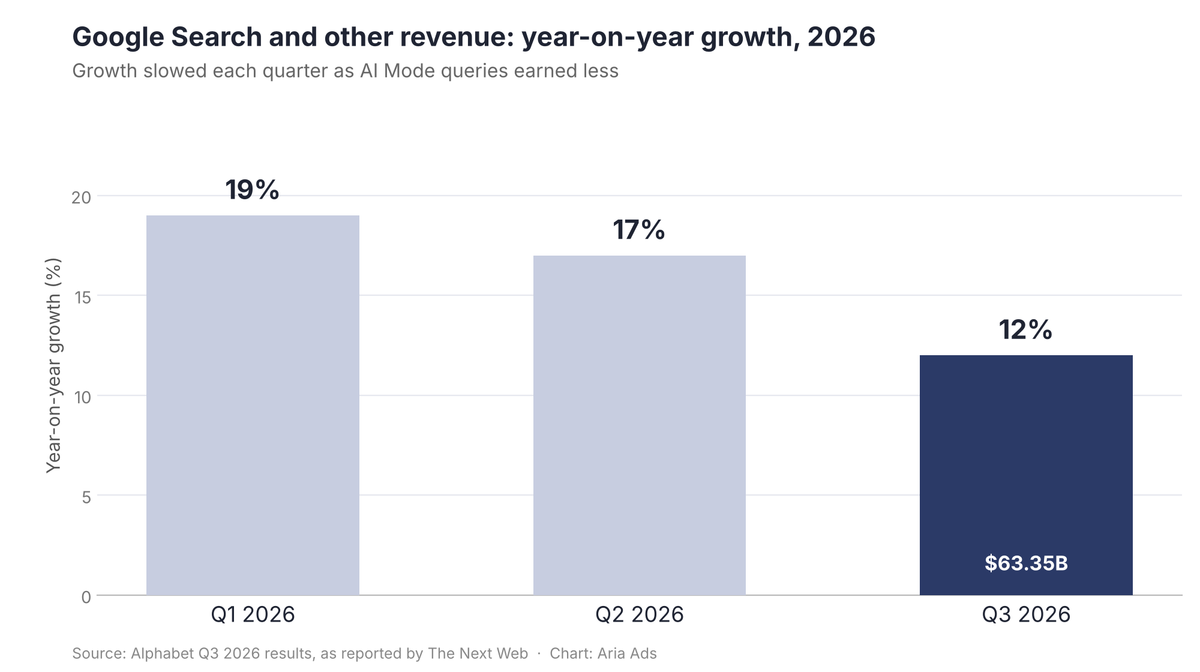
- Google Search and other revenue grew 12% to $63.35 billion in the third quarter of 2026 to $63.35 billion in the third quarter of 2026, down from 19% growth in the first quarter, and Google said the lower monetization of AI Mode queries contributed, a disclosure that sent Alphabet shares down more than 12% in early trading on October 29, 2026.
- Google is now scaling ads inside AI Overviews and AI Mode, which began showing ads in 10 more countries in October 2026, and says click-through rates for sponsored and organic product listings in AI Mode are already similar.
- Amazon's advertising business earned nearly $20 billion in the third quarter of 2026, up 12% year on year, as Amazon launched Ads Agent, a system that plans, runs and adjusts campaigns from natural-language instructions.
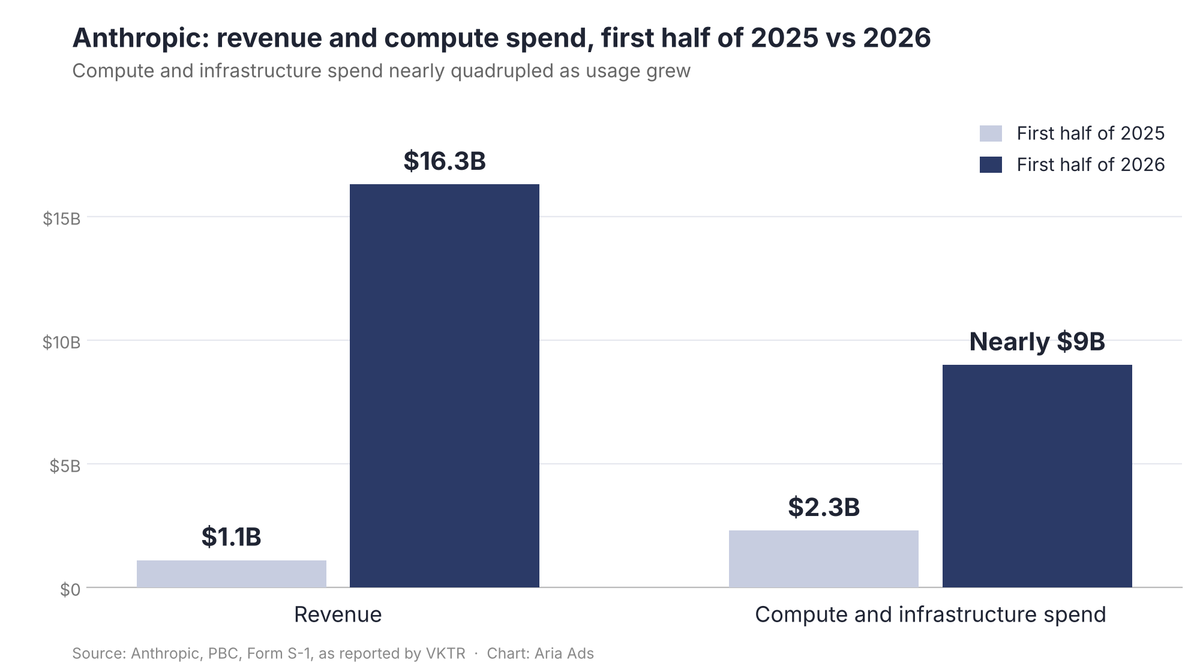
- Anthropic spent nearly $9 billion on compute and infrastructure in the first half of 2026, up from $2.3 billion a year earlier, according to coverage of its S-1 filing, which shows how quickly the cost of serving AI users grows with usage.
How can brands reach shoppers who use AI to research purchases?
Brands that want to reach shoppers using AI should look past general chatbots, because in Aria Ads' data 88% of prompts on vertical assistants carried commercial intent, compared with 6 to 7% on general assistants such as ChatGPT and Gemini.
The difference comes from why people open each kind of app. Someone asking a general chatbot a question is usually learning, while someone asking their running coach app which shoes to buy for a bad knee is close to making a purchase. In the weeks before Black Friday, that second kind of question is the one retailers most want to be part of, and in Aria Ads' data it happens mostly inside specialist apps for shopping, fitness, travel and similar tasks.
This has a practical consequence for how brands measure their visibility. There is one Google, but there will be thousands of vertical assistants, each deciding which products to recommend in its own way, and most of them do not appear in the search and analytics tools brands use today. Aria Ads' view is that brands should track their share of voice in both places, since general assistants shape awareness while vertical assistants are present at the moment of purchase.
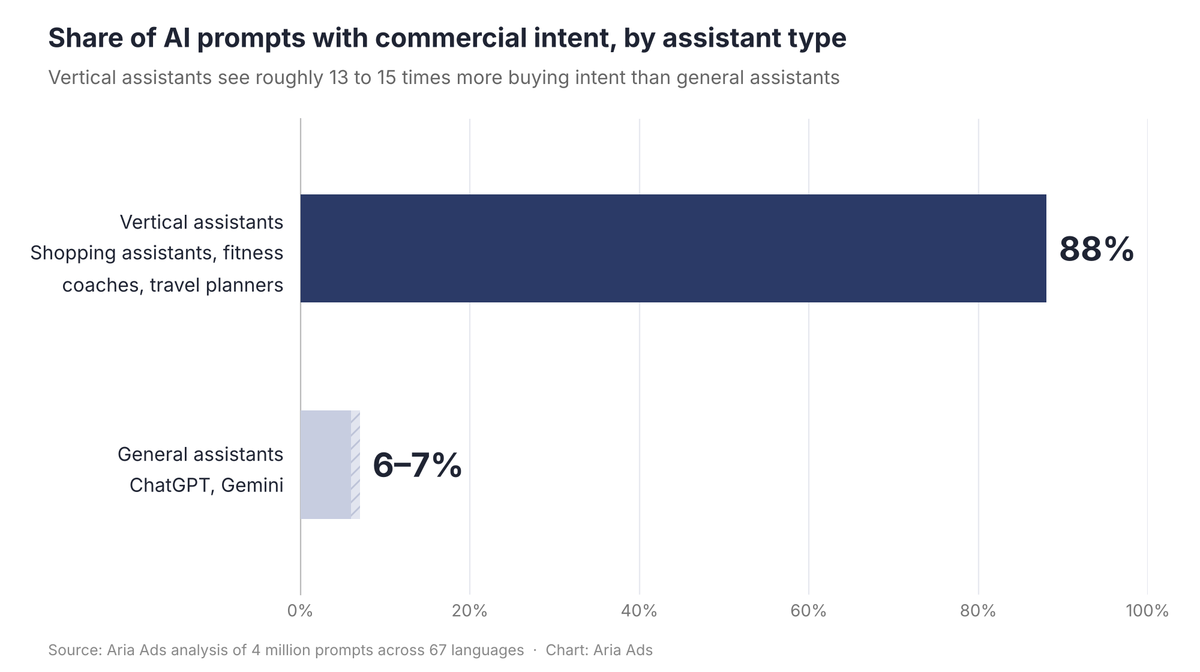
For AI app developers, the same finding means that the developers of vertical apps hold the conversations advertisers value most, even when their user numbers are far smaller than those of the general assistants.
Are Google and other AI assistants showing more ads in 2026?
Google is adding more ads to its AI search answers after reporting that searches in AI Mode earn less than traditional searches. In its third-quarter 2026 results, Google Search and other revenue grew 12% to $63.35 billion, down from 19% growth in the first quarter and 17% in the second, and missed analyst estimates for a second straight quarter. Philipp Schindler, Google's chief business officer, said on the earnings call that "the strong growth in AI Mode queries had an impact because of the lower monetization we were seeing in AI Mode." Alphabet shares fell more than 12% in early trading on October 29, 2026, which erased about $511 billion in market value.
Google's response is to put more ads into AI answers. Schindler said Google is scaling ads inside AI Overviews and AI Mode, and ads in AI Mode reached 10 more countries in October 2026: Australia, Canada, India, Kenya, Malaysia, New Zealand, Nigeria, Pakistan, the Philippines and Singapore, with Brazil, Mexico and the UK planned for the fourth quarter. In the US, Google is adding ads to follow-up questions in AI Mode, and it says click-through rates for sponsored and organic product listings in AI Mode are already similar.
For advertisers, AI answers are becoming a standard ad placement at the largest search company. For AI app developers, Google's results show that answers in a conversation are harder to monetize with search-style ads, even at Google's scale, which is a strong signal that smaller AI apps need ad formats designed for conversations from the start.
Are AI agents starting to shop for consumers?
Over the past year, the tools that let AI agents find, choose and pay for products on someone‘s behalf have moved from experiments into the major payment networks, and they are already reshaping advertising. Mastercard‘s Agent Pay, built on the open-source x402 protocol, lets AI agents complete transactions with retailers and government services using credit cards, debit cards or stablecoins. Stripe and OpenAI developed the Agentic Commerce Protocol, an open standard that lets AI agents and businesses complete a purchase inside a conversation, and ChatGPT uses it for checkout. Through the protocol‘s Shared Payment Tokens, the business receives a token in place of the buyer‘s card details. Each token works only for one seller, up to a set amount and until it expires.
| Company | Launch | What it does |
|---|---|---|
| Mastercard | Agent Pay ("Pay for Machines") | Lets AI agents pay retailers and services, built on x402 |
| Stripe | Agentic Commerce Protocol (with OpenAI) | Open standard for completing purchases inside AI conversations, used for checkout in ChatGPT |
| Stripe | Shared Payment Tokens | Lets an agent pay with a buyer‘s saved card, limited to one seller, amount and time window |
These launches matter for advertisers because click-based measurement weakens when an agent, not a person, reads the page and places the order. In Aria Ads‘ view, the biggest unsolved question in agentic commerce is attribution: who earned the sale when an agent made the recommendation. Checkout standards such as the Agentic Commerce Protocol bring agent purchases into a defined, trackable flow, which is an early step toward answering that question. No common standard yet connects a sale to the recommendation that led to it.
How do AI apps cover inference costs for free users?
AI app developers pay for the computing behind every prompt a free user sends, and the spending disclosed by AI model companies in 2026 shows how quickly that cost grows as usage grows. According to coverage of Anthropic's S-1 filing, the company spent nearly $9 billion on compute and infrastructure in the first half of 2026, up from $2.3 billion in the first half of 2025, while its revenue rose to $16.3 billion from $1.1 billion. The filing also lists about $450 billion in cloud agreements over the next seven to 10 years.
Developers who build on these models pay for the tokens their users consume, so an AI app with a large free tier carries a cost for every user who never subscribes. Advertising inside the conversation is one way to earn from those users, and Aria Ads' prompt data suggests the opportunity is largest in vertical apps, where 88% of prompts carry commercial intent.
Method
This report combines Aria Ads’ own prompt dataset with public company disclosures, company documentation and news coverage published between October 22 and October 30, 2026. Aria Ads labeled 4,000,000 prompts written in 67 languages. A prompt only counts as commercial when it meets the criteria for every label in a fixed set, which covers the category (for example travel or shopping), the task the person is asking for (research, advice or a comparison), and where they are in the buying journey, from discovery through consideration to a decision. Aria Ads also labels sensitivity, so any prompt that involves personal data or a sensitive topic such as health or children is marked as having no commercial intent and is never matched with an ad.
The labeling is done by Aria Ads’ own machine learning classifier rather than a large language model, because an LLM’s answers are probabilistic and Aria Ads needs labels that stay consistent from one run to the next.
Assistants were grouped as vertical when the app is built for one task or category, such as shopping, fitness or travel, and as general when the app answers questions on any topic.
The third-party figures come from company filings, earnings calls and company documentation, as reported or published by the sources listed under Sources. Aria Ads’ weekly market intelligence process reviewed more than 10,000 data points for this edition, and each figure used here was checked against its original coverage before publication.
Limitations
- The prompt dataset was not limited to the holiday season, so this report does not measure Black Friday shopping behavior separately from the rest of the year.
- Intent labels describe what users asked, which is different from whether they went on to buy something, and Aria Ads does not yet have purchase data to connect the two.
- The prompts are historical, and because people’s use of AI assistants is changing quickly, the results are better read as showing the direction things are moving than as a fixed number.
- Company figures are self-reported, and the Alphabet share decline reflects early trading on October 29, 2026, not the closing price.
Definitions
- Commercial intent: a prompt in which the user is looking to buy, compare or choose a product or service.
- Vertical AI assistant: an AI app built for one task or category, such as shopping, fitness coaching or travel planning.
- General AI assistant: an AI app that answers questions on any topic, such as ChatGPT or Gemini.
- AI Mode and AI Overviews: Google's AI-generated answers in search, where AI Mode is a conversational search experience and AI Overviews are summaries shown above search results.
- Agentic commerce: shopping in which an AI agent researches, chooses or pays for products on a person's behalf.
- Inference cost: the computing cost of generating an AI model's response to a prompt.
Frequently asked questions
What share of AI prompts show buying intent?
The share depends heavily on the kind of app, and in Aria's analysis of 4 million prompts across 67 languages, 88% of prompts on vertical assistants such as shopping assistants, fitness coaches and travel planners carried commercial intent, compared with 6 to 7% on general assistants such as ChatGPT and Gemini.
Where do shoppers use AI to research what to buy?
Aria Ads' data shows that buying questions are concentrated in vertical AI apps built for a specific task, where people ask for product recommendations, prices and comparisons. General assistants see far more learning and research questions, with only 6 to 7% of prompts carrying commercial intent.
How do I get my brand recommended by ChatGPT?
General assistants like ChatGPT mostly answer learning questions, so they shape awareness of a brand more than they drive purchases, and brands benefit from clear, complete product information that these assistants can read. Because 88% of prompts on vertical assistants carry buying intent, Aria Ads recommends that brands also track how often they are recommended in vertical AI apps, where shoppers are closer to buying.
Is Google showing ads in AI Mode?
Google said in October 2026 that it is scaling ads inside AI Overviews and AI Mode, that ads in AI Mode reached 10 more countries that month, and that it is adding ads to follow-up questions in AI Mode in the US.
Can AI agents buy things for consumers?
Yes. The infrastructure for it arrived over the past year. Mastercard‘s Agent Pay lets AI agents pay retailers and services, Stripe and OpenAI‘s Agentic Commerce Protocol lets shoppers complete purchases inside AI conversations such as ChatGPT, and Amazon‘s Ads Agent runs ad campaigns from natural-language instructions.
Why are AI app developers looking for new ways to monetize free users?
Serving AI responses is expensive and the cost grows with usage. Anthropic spent nearly $9 billion on compute and infrastructure in the first half of 2026, up from $2.3 billion a year earlier, and developers who build on AI models pay for every prompt their free users send.
How can AI app developers monetize their free users?
Developers usually rely on subscriptions and usage limits, but those earn nothing from free users who never upgrade, so advertising inside the conversation is a way to earn from every free session. The opportunity is largest in vertical apps, where 88% of prompts in Aria Ads’ data carry commercial intent, because a relevant recommendation can appear while the user is deciding what to buy. The format matters too: Google’s results show that search-style ads earn less inside AI answers, which points to ad formats designed for conversations.
About Aria
Aria Ads is an ad network built for AI apps. It helps AI app developers earn money from their free users by showing relevant recommendations inside the conversation. Advertisers reach people with high intent while they discover, compare and decide what to buy. Learn more at trustaria.co.
How to cite this report
Aria Ads, "AI Shopping Before Black Friday 2026," November 2026, trustaria.co/research/reports/ai-advertising-report-black-friday-2026
Sources
- Alphabet shares fall 12% after Google says AI Mode searches earn less, The Next Web, October 29, 2026
- Amazon's Ads nears $20 billion in Q3 as it bets on agentic AI to fuel further growth, Digiday
- Anthropic's S-1 shows $16.3B in revenue and compute squeeze, VKTR
- Anthropic, PBC, Form S-1, SEC
- AI agents are shopping like never before, and tools like Mastercard's 'Pay for Machines' could turbocharge the trend, Fortune, October 26, 2026
- Agentic commerce, Stripe documentation
- Agentic Commerce Protocol (ACP), OpenAI and Stripe, GitHub